Product6 min read
Automate your Hyperliquid strategies
Funding flips at 4 a.m., stops go missing, and the dip is gone by breakfast. Run your Hyperliquid strategies around the clock, funded from your Solana wallet, with every order checked before it signs.
Hyperliquid never closes. On November 23, 2026 its own API listed 179 perps and $7.4 billion of volume over 24 hours. Every one of those markets settles funding every hour, and every one can move while you sleep.
If you trade there, you probably already have an edge you believe in. The hard part is being present for it: every hour, with the same rules, at the same size. Solaris AI runs that part. You describe the strategy, it becomes a workflow, and it trades your own Hyperliquid account with USDC from your Solana wallet.
The hours you can't watch
Here is SOL's funding for the 30 days to November 23. When it is below zero, shorts pay longs.
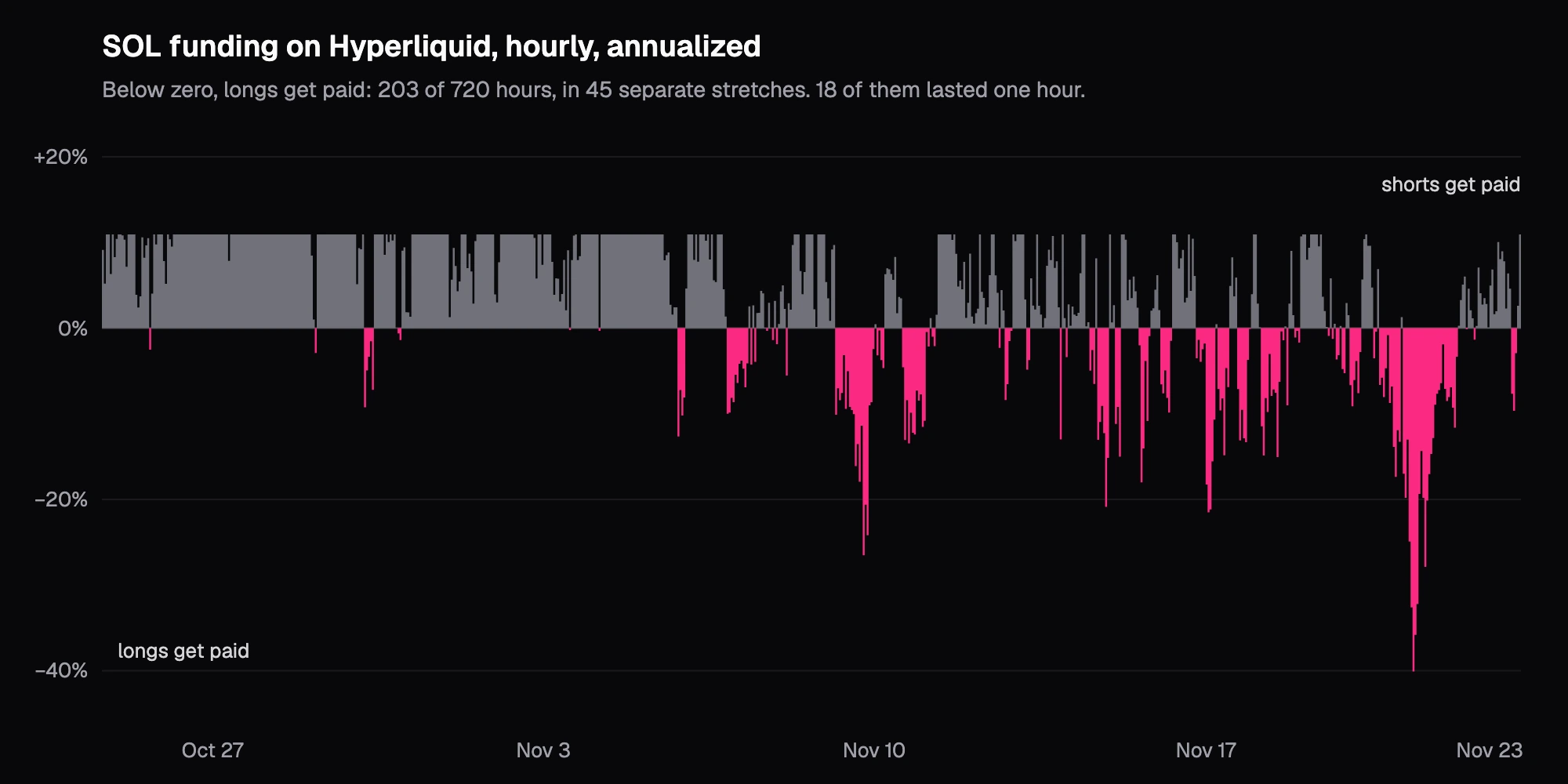
Funding was negative in 203 of 720 hours, split into 45 stretches. The longest ran 28 hours. Eighteen lasted a single hour. Nobody catches that by refreshing a tab, and catching all of it is a mistake too. Holding a $10,000 long through only those negative hours would have collected about $20 in funding. Opening and closing it 45 times would have cost about $405 at Hyperliquid's base taker rate of 0.045%.
So the edge is in the rule: wait for funding to stay negative, enter once, protect the position, and leave it alone until something changes. Rules like that are easy to write down and very hard for a person to follow all month.
Five strategies worth automating
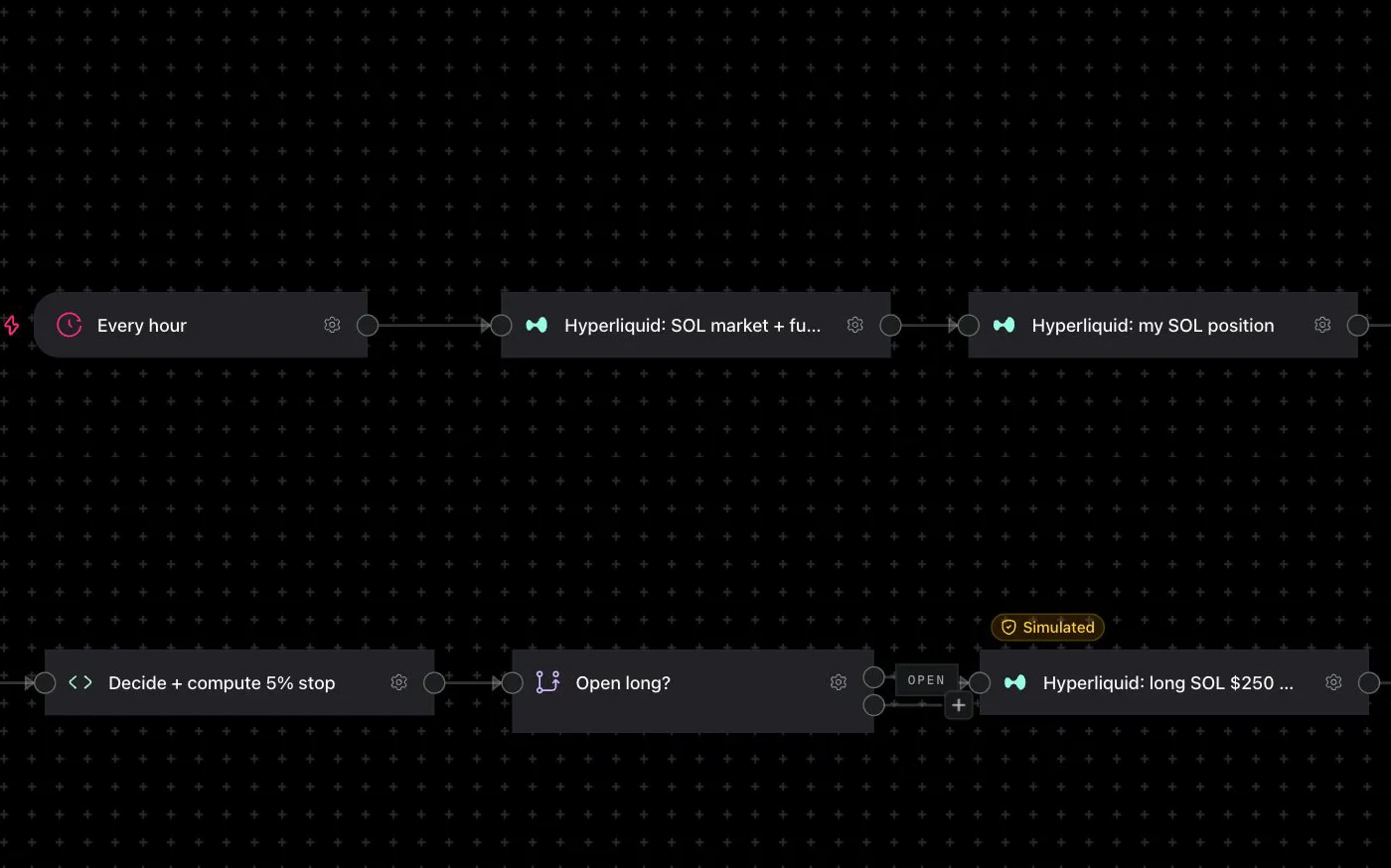
1. Funding as a filter. Go long only after funding has stayed negative for a few hours and you hold nothing in that market. You are buying when the crowd is paying to be short. The stop and take profit go on with the entry.
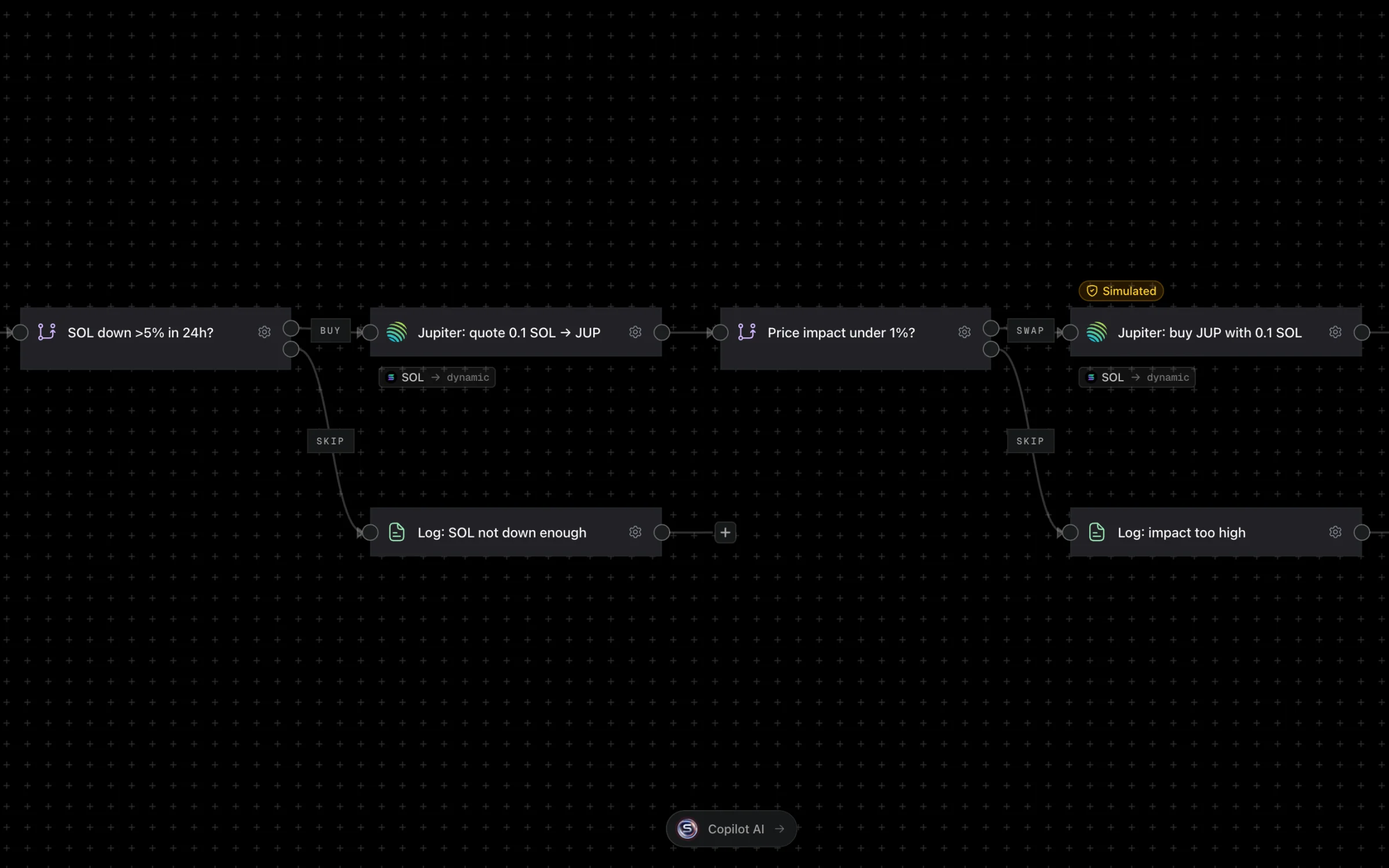
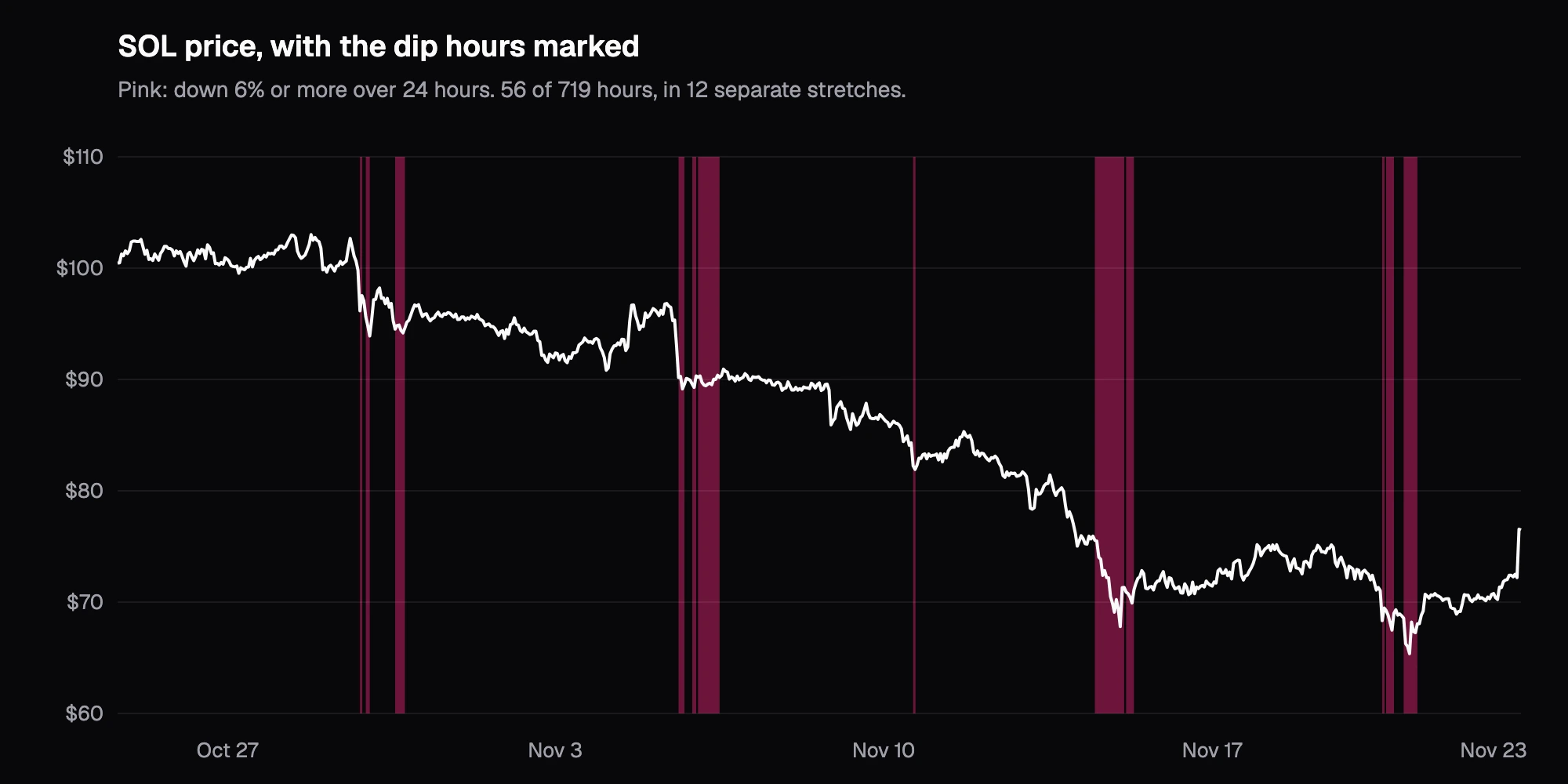
2. Buy the dip, with a stop. Over the last month SOL was down 6% or more in 24 hours for 56 of 719 hours, across 12 stretches. It also fell from about $100 to about $77, so many of those dips kept going. The stop decides whether this strategy survives a month like that. A workflow can check every hour, deposit from Solana only when the dip is real, open a small long with a stop and a target, and send the USDC home when the trade is over. Your money sits on Hyperliquid only while it has a job.
3. Follow a trader. Every Hyperliquid account is public. Read an address every few minutes, act when its position changes, and use your own size, leverage and stop. A profitable account is not always worth following: you enter after it does, so start on paper and compare your entries with theirs.
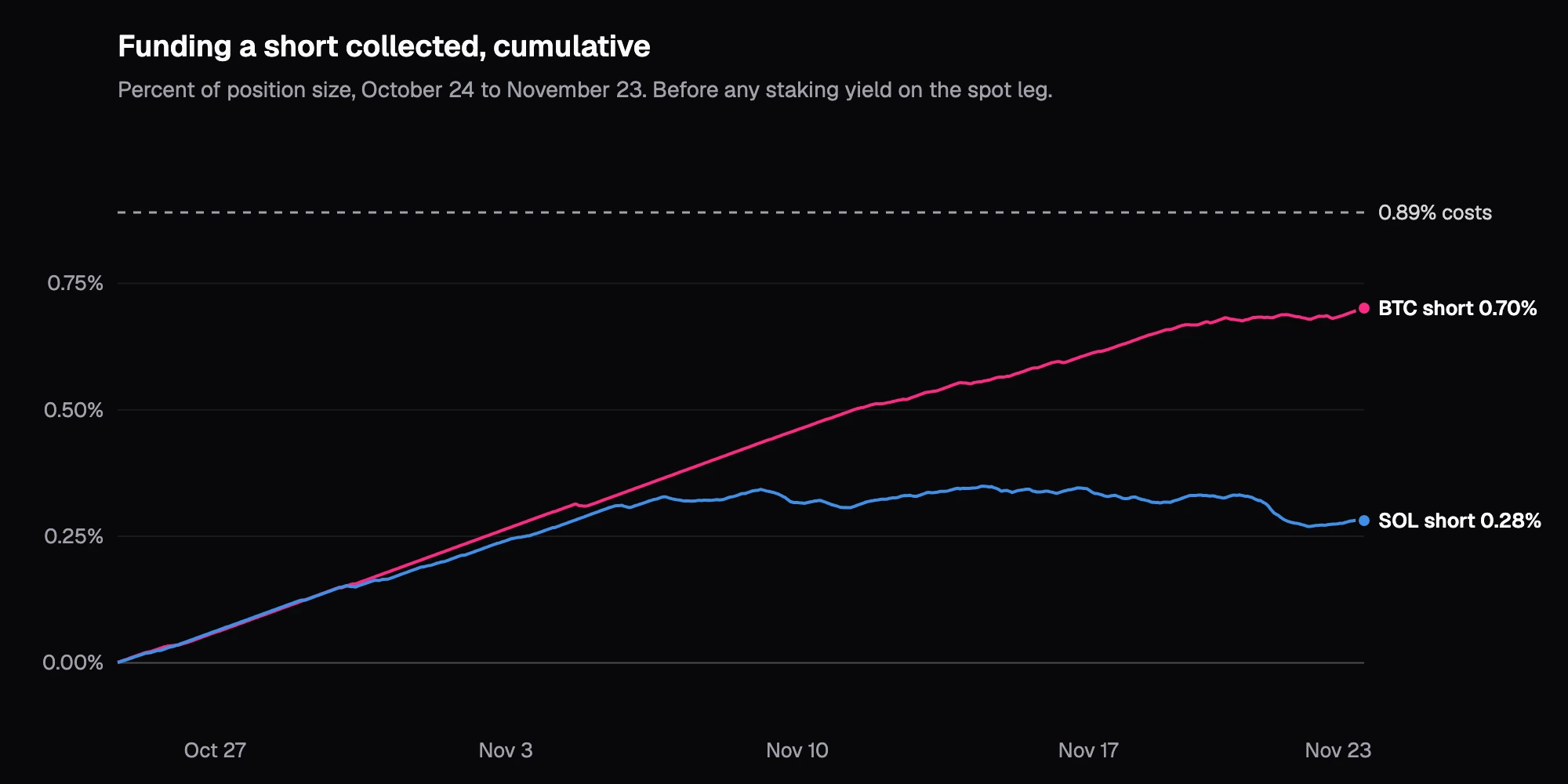
4. Carry. Own the asset on Solana, short the same amount on Hyperliquid, and collect funding while longs pay for it. Price moves largely cancel out, though the short can still be liquidated in a rally if nobody adds margin. Over those 30 days a BTC short collected 0.70%, or about $70 on $10,000, and a SOL short 0.28%, on top of any yield if your spot leg is a liquid staking token. The spot swaps and perp fees come to about 0.9% for the full round trip, so at that month's rate BTC carry would take about 38 days to pay for itself. Carry is a hold, and the work is in the holding: watch the short's margin, deposit more USDC from Solana when it runs low, and unwind both sides when funding turns. A workflow can do all three.
5. Protect what is open. Check that every position your workflows opened still has its stop and put back the ones that are missing. Close half before the weekend. Get a Telegram message when funding crosses your number. It makes nothing on a good day and can save the month on a bad one.
If you already trade on Hyperliquid
The Hyperliquid node speaks the exchange's own terms: market and limit orders, post-only and immediate-or-cancel, cross or isolated, reduce-only closes, take-profit and stop-loss triggers, and your own client order ids. Reads cover books, candles, funding, fills, open orders and any account's positions.
It trades from a separate Hyperliquid account under your login, so the positions on your main account stay out of its reach. Send USDC to it from your main account inside Hyperliquid, instantly and with no bridge, or fund it from your Solana wallet through Relay. No API key, and the private key never leaves Privy.
Builder-deployed (HIP-3) markets aren't covered yet.
The rules hold when you aren't looking
Every trading step starts in Dry run. It prices the real order against the live market and signs nothing, so a strategy can run on paper for a week before it trades a dollar.
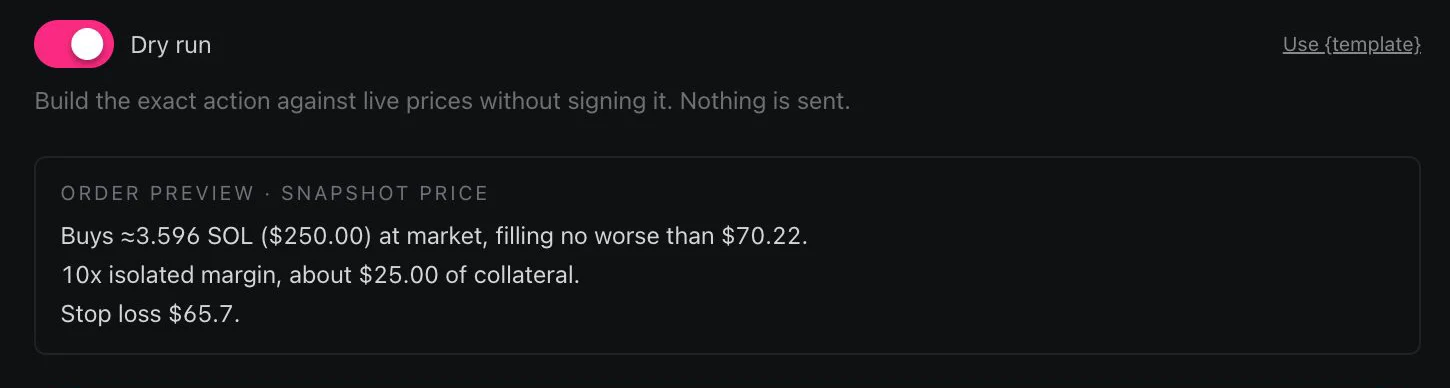
When it is live:
- A worst price on every market order. 1% from mid by default. What can't fill inside it is cancelled.
- An order is sent once. The engine never retries a step that signs on Hyperliquid. If the reply is lost, the node looks the order up by its id and reports what it found instead of sending it again.
- A missing stop is a failure. If the entry fills and its stop doesn't go on, the step fails and the run stops.
- A close can't flip you. It is reduce-only, and a flat market is a clean "no position".
- A broken schedule pauses. Four failed runs in a row and it stops until you turn it back on.
Every run records what each step returned, so you can see why it traded and why it didn't. Run history goes back 7 days, or about 30 hours for schedules faster than every 5 minutes.
From your rule to a running strategy
Write the rule as you would say it. Copilot turns it into nodes you can open and edit, adds the guards you left out, and lists every assumption it made.
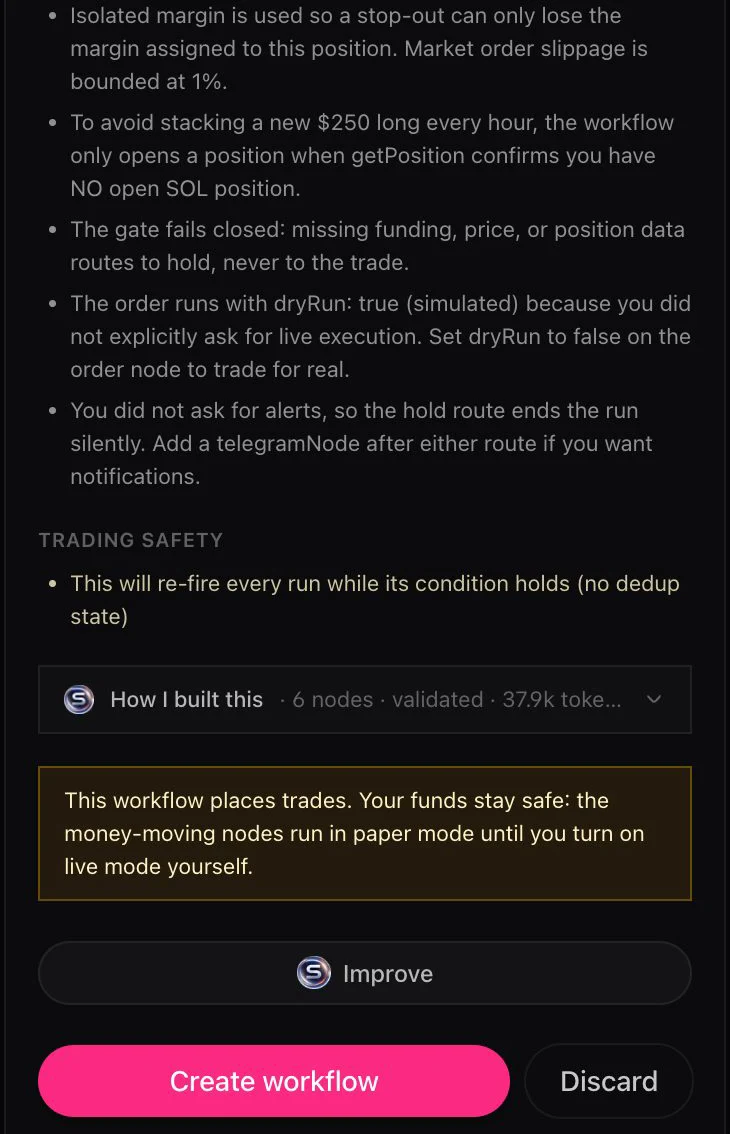
Read those notes. This one warns that the rule can fire again on every run while its condition holds, so after a stop-out it could re-enter the next hour. If you want a cooldown, say so in the prompt.
An hourly strategy is 720 runs in a 30-day month. At the base 3 credits a run, that is 2,160 credits, or about 22 cents, and every account gets 50,000 free credits a month. Solaris AI adds no fee to your Hyperliquid fills today.
Why this matters for Solaris AI
For anyone looking at Solaris AI as a business, the useful number is how often it runs. A trading app earns when someone shows up. A strategy that checks the market every hour runs 720 times a month whether anyone shows up or not, and every run spends credits.
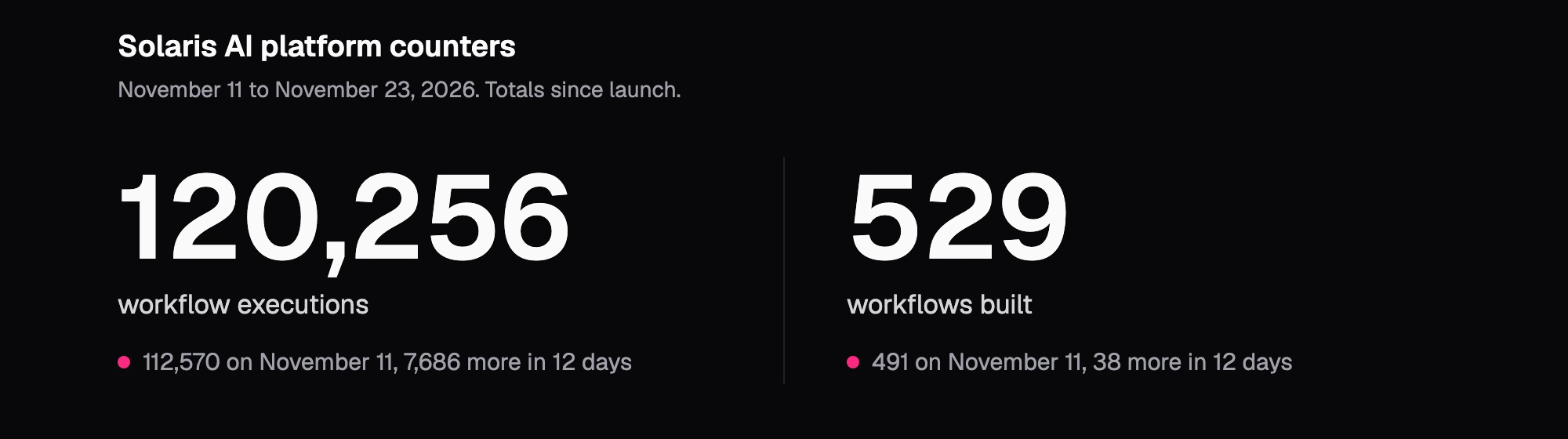
On November 23, 2026 the platform counters read 120,256 workflow executions and 529 workflows built. On November 11 they read 112,570 and 491. That is 7,686 more executions in 12 days.
Hyperliquid adds a venue that trades billions of dollars a day to that engine, and keeps Solana as the home base: the wallet, the funding and the profits that come back. A single workflow can now hold spot on Solana and a hedge on Hyperliquid, and manage both. Swaps on the Solana side already carry the standard platform fee.
Start
Automation won't make a losing rule profitable, and leverage makes it lose faster. Stops can fill worse than their trigger in a fast market. What you get is your own rule, applied every hour, with a record of each decision.
Pick one of the five, start it on paper, and watch what it would have done. The box below has the funding filter ready to edit.